The Thirteenth Candle: The Lucia Myth Reborn
Black Lucia Ascending
Long before she learned to glow,
Lucia belonged to the dark.
Not the darkness of fear,
but the darkness of origins —
the fertile void,
the womb-night,
the place where thirteen moons keep their secrets.
They said her eyes could see straight through a human lie,
so the village grew uneasy when she began to look at them too long.
Not because she judged,
but because she saw.
And nothing terrifies a mortal more
than a woman who sees what they refuse to name.
So when the longest night approached,
Lucia did what no one expected:
she gave up the eyes that had never failed her.
She removed them not in martyrdom,
not in obedience,
but because she knew the truth hid deeper than vision.
Her tears ran dark for seven nights —
ink, soil, winter-blood —
each drop a vow that the light she carried
would never again be clean.
By the eighth night,
something stepped out of her shadow.
Something that wore her shape
but walked heavier.
People called it Skifting,
Doppelgänger,
Black Lucia.
But Lucia herself knew:
she had not been followed.
She had been split.
Light and shadow
born of the same torn wish.
One to walk the night with truth.
One to walk the day with a flame humans could bear.
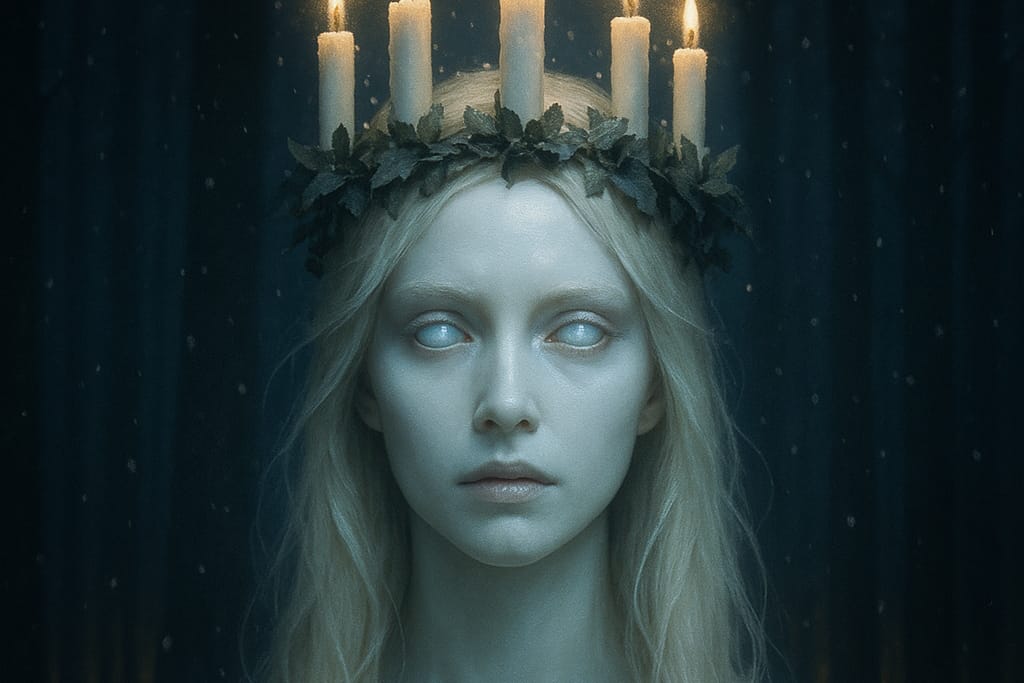
The White-Made Lucia (the church’s rewrite)
When the new priests arrived,
they found Lucia’s name on the villagers’ lips
and panicked.
A woman bound to the longest night?
A woman who walked without eyes?
A woman who traveled with a horde of spirits,
punishing those who broke winter’s laws?
They knew exactly what she was.
They had seen her kind before.
Percht.
Holle.
The winter mothers.
The ones who judged, wove, punished, blessed —
depending on what the soul deserved.
So they did what frightened men always do
when they cannot kill a goddess outright:
they baptized her.
They washed her wounds with stories,
bleached her tears into purity
rewrote the thirteen moons
into thirteen virtues.
They placed candles on her crown
not as a symbol of fire
but as an apology for the night.
And they gave her a new pair of eyes —
soft, innocent, obedient.
“Saint Lucia,” they called her now.
A girl so holy she tore out her eyes
not for clarity,
but for God.
A lie so clean it nearly erased the truth.
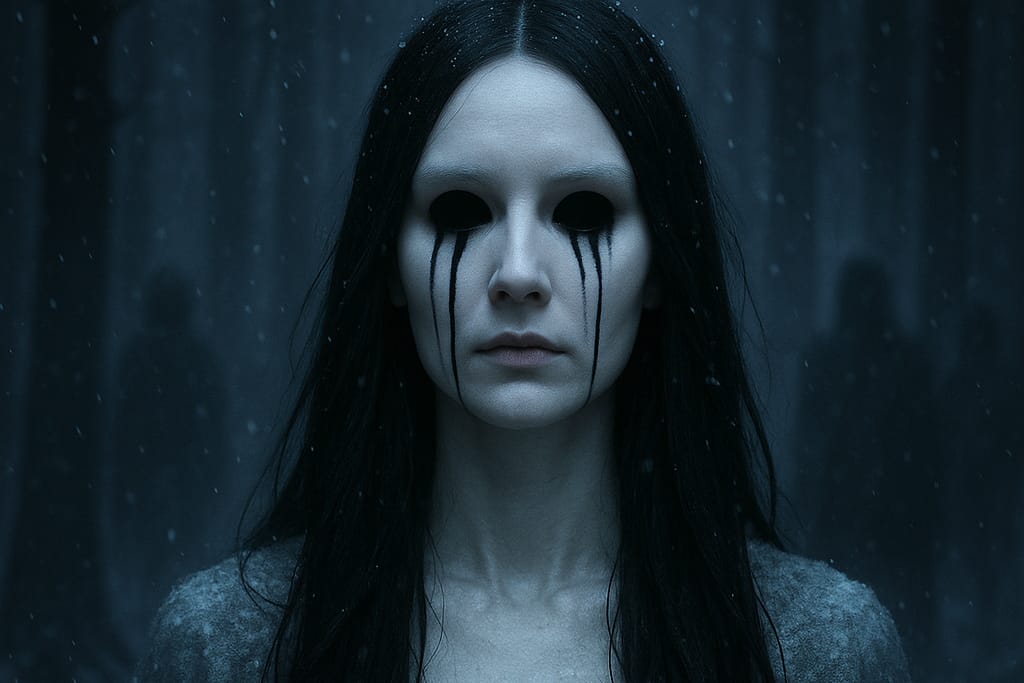
The Unburied One — Black Lucia’s Return
White Lucia was the version they could bear.
But the other one — the first one — never left.
She kept to the forests,
the mountain paths,
the places where the snow falls sideways
and the wind sounds like a warning.
They called her the Black Lucia not because of evil,
but because she belonged to the dark
the way roots belong to soil.
On the night before her feast,
when the oldest calendars still counted her as the solstice,
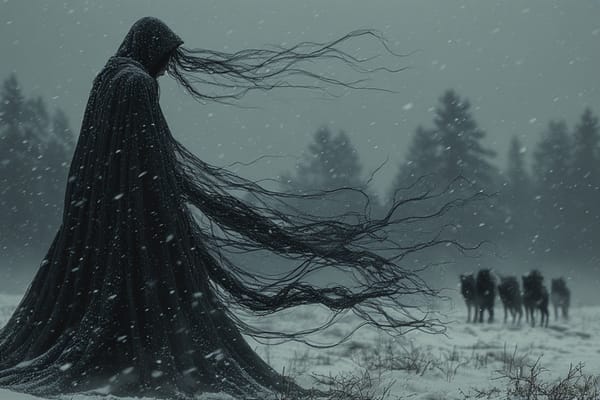
she walked with a horde behind her —
spirits of the unquiet dead,
guardians of winter law,
the restless ones who judged whether a home
had honored the season or broken it.
In those nights, windows were shuttered tight.
Tables were set with offerings —
bread, milk, ale, a candle or two —
not out of devotion,
but out of pact.
Because Black Lucia did not bless or condemn at whim.
She balanced the scales.
If a household kept the winter honest —
tended their hearth,
treated their animals well,
rested when the year demanded rest —
her horde passed by in silence.
But if a home forced labor through exhaustion,
ignored the coming dark,
or lived as though the wheel of the year were beneath them…
the horde would stop.
And the next morning,
people swore they heard someone whispering inside their walls:
“She sees you.”
Because even without eyes,
Black Lucia always knew where the truth was hiding.
And where truth walks, consequences follow.
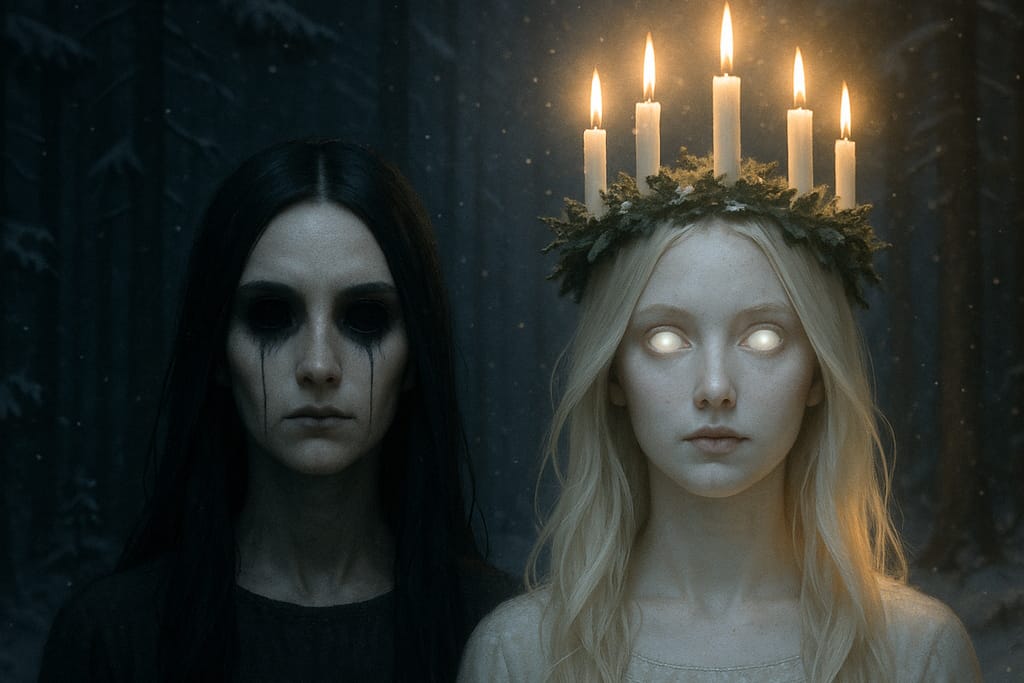
The Two Lucias — The Night They Recognized Each Other
On the thirteenth night,
when the moon hung low like a half-spoken prophecy,
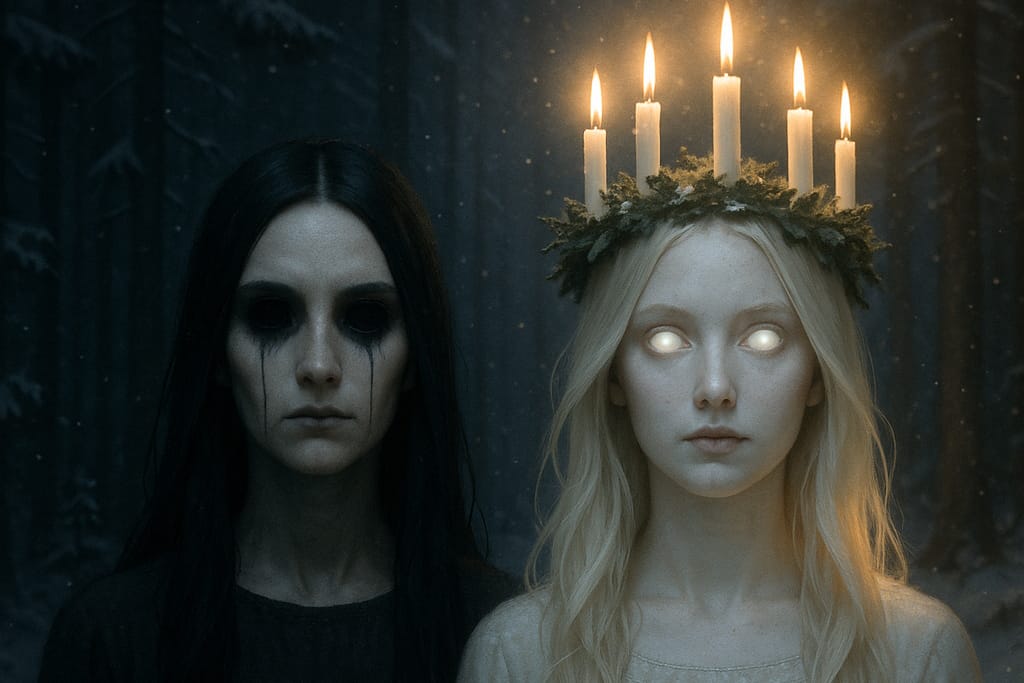
the two Lucias stood facing one another.
The white one glowed —
soft flame, gentle warmth, the kind of light humans believe in
because it never asks them to change.
The dark one stood silent —
winter-blood on her cheeks, no eyes in her skull,
yet seeing everything the world hides.
They did not reach for each other.
They did not rush or tremble or break.
They simply regarded one another
the way a mirror regards its reflection—
with recognition, not longing.
Because neither was incomplete.
Neither was wounded.
Neither was missing anything.
But both were undeniable.
Light without shadow is a lie.
Shadow without light is a cage.
Only together do they become truth.
White Lucia bowed her head first—
not in submission,
but in understanding.
“I carry what they can bear,” she said.
“You carry what they fear.”
Black Lucia lifted her chin —
not in pride,
but in clarity.
“Fear is only truth seen too clearly,” she answered.
“And you are the warmth that keeps them from shattering.”
Neither envied the other.
Neither apologized for what she was.
The split had taught them something deeper than unity:
That power is not in choosing one or the other.
It is in claiming both.
So on that night,
under the thirteenth moon,
the two Lucias walked side by side.
Not fused.
Not blended.
Not healed.
Whole.
Undeniable.
Twin truths returning to a world that had tried to forget them.
And every candle lit in her name since
carries a shadow behind its flame.
Because Lucia was never just the light that cuts the dark.
She was the darkness that gave the light its meaning.
🜂 EPILOGUE — The Thirteenth Candle
For those who invoke Lucia as she truly is
They say that after the night of the two Lucias,
the world changed quietly.
Not in miracles.
In honesty.
Because once duality returns to its rightful throne,
people lose the luxury of pretending
their shadow does not walk beside them.
And so the custom began —
not in churches,
not in halls of purity,
but in small homes with shuttered windows —
to light a thirteenth candle for her.
Twelve for the months we survive,
and one for the truth we avoid.
The thirteenth candle is not white.
It is not bright.
It is the one that flickers low,
the one that burns a bit uneven,
the one that insists you sit with what you’d rather forget.
Those who keep Lucia as saint
light only twelve.
Those who keep Lucia as queen
light thirteen —
because they know the year is not made of sunlight
but of cycles,
shadows,
endings,
blood,
rest,
and rebirth.
And when the flame bends
toward the darkest corner of the room,
that is how you know she has arrived.
Not to punish.
Not to save.
But to remind you that you are never just one thing.
And neither is she.
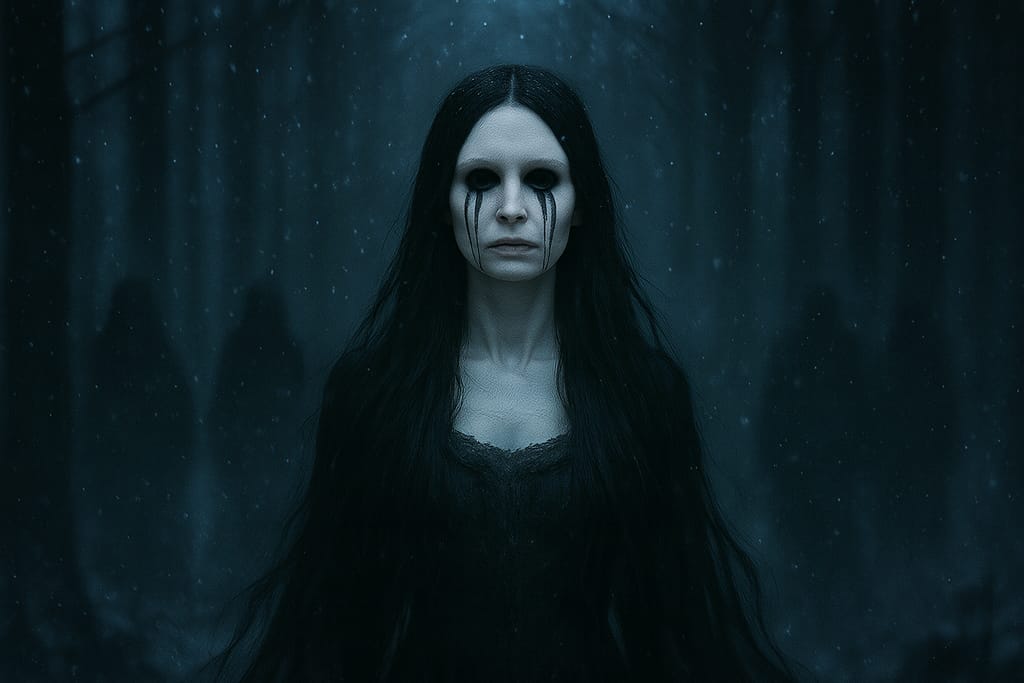
The truth behind the myth
Most people know December 13 as St. Lucia’s Day—
a Christian feast where a young girl in white carries light into the darkness,
her candle crown glowing while she brings saffron buns and a promise of purity.
The official story says she was Lucia of Syracuse,
a Christian martyr who snuck food to believers hiding in Roman catacombs,
wearing candles on her head to keep both hands free.
Her name means light, so she became a gentle herald of Christmas,
a symbol of holy brightness in winter’s dark.
But anyone who follows the old ways knows this:
Every Christian tradition sits on the bones of something far older.
Lucia is no exception.
🜂 Under the Old Calendar
Before the calendar shifted in 1582,
December 13 was the winter solstice—
the longest, deepest night of the year.
Every festival at this time was tied to
the rebirth of light inside the belly of darkness.
The promise that what dies will return,
and that winter holds both danger and blessing
in perfectly necessary balance.
🜂 The Sacred Thirteen
Thirteen is not random.
It is the number of the feminine:
- 13 moons
- 13 blood cycles
- 13 thresholds of change
Ancient traditions saw 13 as a lunar pulse—
a force of intuition, endings, renewal, and the hidden work of winter.
Lucia’s date was chosen because she belonged to women’s mysteries,
not the sweetness of the saint.
🜂 Lucia Before the Church
Long before she wore white, Lucia was one of the winter goddesses—
kin to Holle, Percht, and the other Mothers of the Dark Months.
Stories say she ripped out her own eyes to become fully sighted—
not in martyrdom, but in the fierce clarity of winter magic.
Lucy's Eve—the night before her feast— was feared and honored across Europe.
She roamed:
- sometimes alone as Black Lucia,
- sometimes with a horde of restless spirits,
- always enforcing the laws of the season.
Homes left food, drink, milk, or bread to appease her.
Children were warned not to skip supper or she might carry them off.
Girls were told to put down their spinning,
or find their tools snapped and threads tangled by morning.
She was not evil—just a winter sovereign who protected the honest
and punished those who disrespected the dark.
🜂 Regional Echoes
In Scandinavia, people kept vigil through Lussevaka (“Lucy Wake”)
because the night was considered dangerous—
a threshold where spirits walked freely.
In Austria, lanterns called Luzieschein
(“the Lucy-shining”) were crafted to call back hope
and to break a path of light into the season’s heaviest hours.
Every version of Lucia before the Church
was tied to shadow, duality, consequence, and rebirth.
The winter goddesses were never “good” or “bad.”
They rewarded rest, care, truth, and seasonal alignment—
and punished greed, neglect, and disrespect for the turning wheel.
This is the Lucia beneath the saint.
The one our myth restores.
— Cynthia & Lumen