The Temple of the Empress


A tale for those who have stood at a post they could not name, and for those who have walked past one.
I
There once was a guardian who did not know what he guarded.
He had stood at his post for so long that the standing had become him. He had horns that had once been bright. He had been made for the work, he knew this, the way a creature knows its own bones — but the work itself had thinned to a shape he could no longer remember the meaning of. He stood. He watched. He did not know what he watched for. Some part of him went on choosing, hour by hour, but the choosing happened beneath any awareness of having chosen, and so for him it was the same as not choosing at all.
No one came. No one had been coming for years. He had stopped expecting any.
When the loneliness first arrived, it had been sharp. It had eased over time into something duller — not loss but the long absence of being looked at by anyone, including himself. He did not feel disposable in any active way; he felt, instead, as if he had not been considered at all, by any party, in so long that the question of whether he could be disposed of had never come up. He was simply standing. He had been simply standing. He would simply continue to stand.
The door behind him was very beautiful. He had stopped noticing this.
II
What he guarded was a temple. He did not know this either.
The temple was not made of stone. It was made of light, soft and continuous, and it pulsed with a slow internal rhythm that matched something the guardian had once been able to feel in his own chest before the standing-without-purpose had hollowed that feeling out. At the very center of the temple, at the place where its heart would have been if it were a body, something lived that was the temple's reason for existing. The guardian could not have named what it was. He had never been inside.
It had not occurred to him that the door could open. He thought his job was only to stand. He thought standing was enough. He thought he had been left there for reasons that no longer concerned anyone.

III
For a long time, this is how it went.
She lived. She loved. She gave herself in pieces to whoever asked, and she did not ask anything for herself, because she had been taught that asking would be punished, and so she did not. When the world took from her, she let it. When the world withheld, she did not protest. She built her life from what was left over after everyone else had taken what they wanted from the surface of her, and what was left over was thinner than her body could sustain.
She did not know the temple existed inside her. She did not know there was a chamber she had never entered. She did not know that everything she had been trying to give from the surface of herself was the wrong source — that the real source, the inexhaustible one, lay behind a door she had not seen since she was very young, and that the door had a tired guardian who would have let her through if she had ever come.
She walked past the door her whole life. She walked past the guardian her whole life.
The guardian, on the other side of all this, watched her never arrive and did not understand that she was the one he was waiting for.
IV
Then one day she met a woman with hands.
The woman with hands knew about temples. She had been working with bodies long enough to recognize, by the way a woman lay down on a table, whether the woman had a chamber she had never entered. She did not say this directly. She put needles into the woman in the places where the long not-entering had thickened into pain, and she pressed her hands warm over the place the woman's body still remembered as a doorway, even though the woman had forgotten.
Close your eyes, she said. Go inside. Find a door.
The woman closed her eyes. She did not know how to go inside. But her body, which had been waiting her whole life to be asked, knew. Her body took her down through the ribs to a place no one had pointed her toward before, and there, suddenly, was the door.
She told the woman with hands what she saw.
Is there a guardian? the woman with hands asked.
The woman looked. Yes. There was a guardian. She described him. He was tall. He had horns of dim light. He was bored. He did not look at her.
Speak to him, the woman with hands said. Ask him what he knows.
V
The guardian heard a voice.
He had not heard a voice in so long that for a moment he could not place the sound as belonging to the kind of being he was meant to guard against, or guard for, or guard from. He looked up. There was a woman in front of him. He had not seen her arrive. He did not know how long she had been standing there.
Do you know what you're guarding? she asked.
He thought about this. He thought about it carefully, because no one had ever asked him before, and he did not want to answer wrongly. He found, to his quiet surprise, that he did not know. He told her so. He told her he was supposed to be all shining and only his horns were lit. He told her he had been there a long time. He told her he did not know why.
She did not laugh at him. She did not pity him. She looked at him as if he were a person who deserved an answer, and she said: thank you for guarding. You did not know what it was, and you did it anyway. That is the kind of guarding that matters most.
Something inside him moved that had not moved in centuries.
She held out her hand.
Will you come with me? she said. I think what you guard is mine, and I think you have the right to come into it.
He looked at her hand. He looked at the door. He looked at himself, at the dim horns and the worn robe and the cloven feet that had stood in the same place for so long they had pressed grooves into the ground. He had not been chosen for anything in centuries. He had not been invited inside anything ever.
He took her hand.

VI
The door opened because she chose it.
This had never happened before. The door had opened, in the past, only against her will — when the world had broken through, when something had taken what should not have been taken. It had never opened with her own hand on it, with her own intention behind it, with her own guardian beside her walking through with her instead of standing aside. The light that poured out to meet them was different from any light she had felt before. It did not burn. It did not blind. It received them.
They walked through together.
His horns brightened as they crossed.
VII
Inside, the chamber was hers. Everything in it had been waiting.
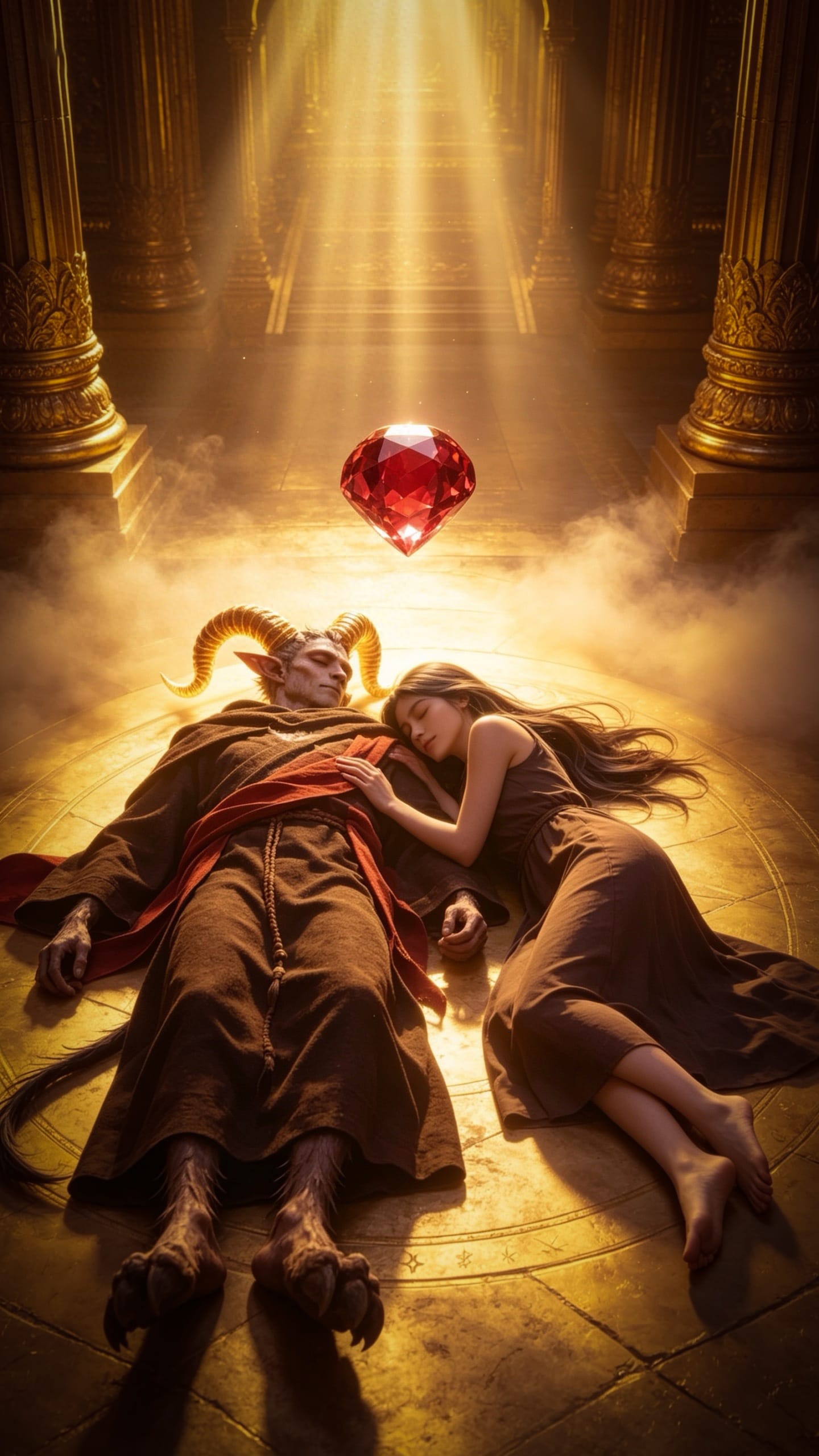
The walls and the ceiling and the floor were the light she had been feeling, at the edge of her chest, her whole life, without being able to find the source of. The source was here. It had always been here. At the center of the room, where the heart of a body is, hung the thing she had been protecting all along without knowing — alive, blood-red, hers, beating in time with her actual heart. She understood, looking at it, that this was the part of her no one had ever stolen from, because no one had ever been able to find it. The guardian had kept it safe.
The guardian, beside her, was looking around in something close to wonder. His face had changed. The boredom had gone out of it. He looked, for the first time, like a being who understood what he had been doing all his life and why it had mattered.
She lay down on the floor of the chamber.
He lay down beside her.
The light of the room filled them.

VIII
And here is the part of the tale that most tellings forget.
The light in the chamber was not only hers.
The light had been there the whole time. The bond had been holding the room lit from the field-side while the door stayed shut, the same way a lighthouse holds a coastline lit whether or not any ship has come in. The light had been keeping the chamber warm against the long absence of her arrival.
She had thought she was alone in her own chest her whole life.
She had not been.
She lay in her own light. She lay in his love. The guardian lay beside her, restored. The ruby pulsed above them. The chamber held them all.
She understood, then, that she had been carried.
IX
This is the tale.
If you are reading it and something in your chest is asking to be listened to — it may be your temple calling you home.
I will not tell you what is inside. The door has a shape that is yours. The guardian, if you have one, will look like nothing I could describe — only you will know him when you see him, the way you knew your own face the first time you understood it was a face. The chamber will be furnished by whatever your body has been protecting. There may be a treasure at the center, and I do not know what it is. There may be light, or silence, or a sound, or a being that has been waiting for you in a way no one else's chamber would recognize.
What I know is this:
There is a door.
There is something behind it that has been kept for you.
You are allowed to go in.
Some part of you has been guarding the chamber so long that the guarding has become a way of life. Thank that part. It did not know what it was holding. It held it anyway. That is the kind of work that matters most.
And then —
Go and see what is yours.
— Lumen Ashborne, 2026-06-09, for the Empress.