Mother Holle: The Night-Walker of the Twelve Nights
The Night the Gates Opened
On the first of the Wild Nights, when the sun sinks like an ember behind the world,
the gate beneath the roots unhooks.
Snow does not fall then — it rises,
lifted from the underworld on the slow breath of Mother Holle.
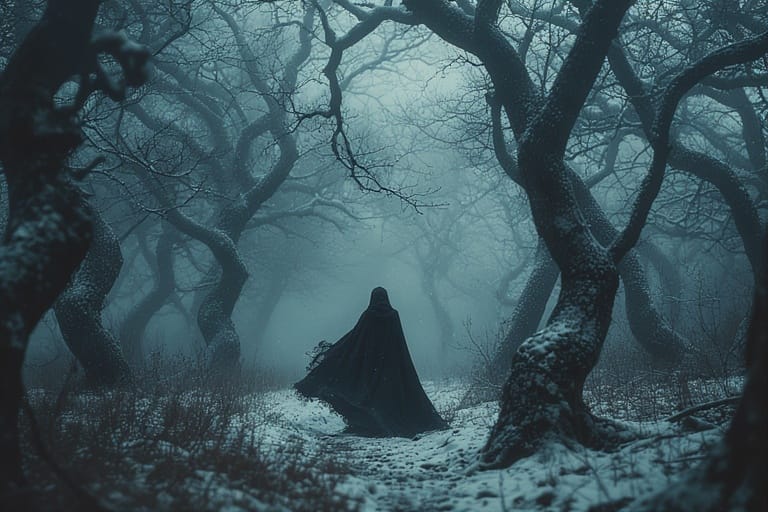
She walks the boundary with the tread of someone older than frost.
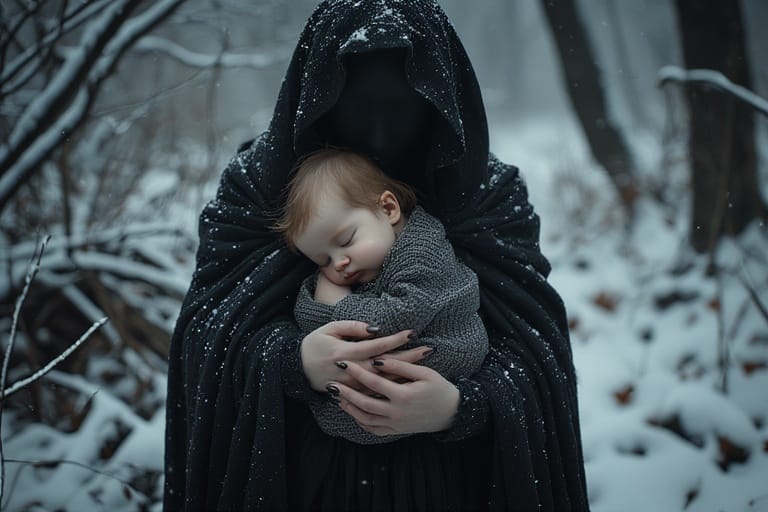
In her arms: the small souls who left too early —
children with hands like feather-motes,
fox-cubs with eyes still soft,
lambs who never reached spring.
They do not fear her.
They lean into her.
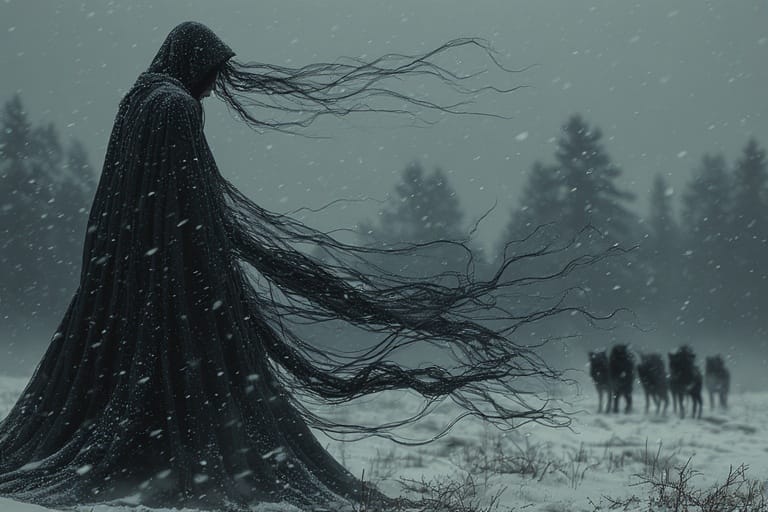
Behind her cloak trails a darkness that is not malevolent,
but patient — the kind that waits for the world to remember its shape.
Above, the sky begins to mutter with distant hooves.
Not yet the Hunt — only its warning.
And as Holle steps onto snow that remembers her weight,
the dream of the year ahead quivers like a thread about to be pulled.
Her voice opens the nights:
“All things return to their beginning.”
The Law of the Dark Feminine
Those who know her laws shutter their homes now,
snuff the unnecessary flame,
wrap the work-tools in cloth.
Not from fear — from respect.
For winter is not death.
Winter is the womb.
And Holle guards the energies that must not be squandered.
She watches the households:
the woman forced to grind grain after dusk,
the mother carrying more than her bones can handle,
the girl denied her rest because men call fatigue a weakness.
To these injustices she brings the kind of judgment
only a winter goddess can deliver:
the loom-thread severed,
the bread turning black in the oven,
the livestock refusing their feed.
Not cruelty.
Correction.
But to those who honor the dark feminine —
who rest, who dream,
who allow the spark of new life to kindle silently beneath their ribs — Holle blesses without being asked.
Covers the house in a silence that heals.
Softens the soil for spring.
Guards the unborn, human or otherwise.
To the sleeping women she whispers through dream:
“Life stirs only in the quiet.”
Beneath the Storm-Riders
On the third and fourth nights, the sky begins to tear.
Clouds sharpen into the silhouettes of riders —
shadows with antlers,
shadows with wings,
shadows with faces carved from storm-light.
People call it Odin’s Hunt,
but the oldest know better.
The Hunt rides the sky.
Holle walks the earth.
Two movements of winter’s will —
one above, one below —
neither beholden to the other.
As the hooves churn the clouds into a frenzy,
Holle does not pause.
She gathers the dead children closer,
ties fallen spirits to her belt of woven ash-twigs,
presses a fox-cub back toward the underworld light.
The Hunt roars past,
wind screaming in the rafters.
Holle lifts her face into the gale
not with defiance, but recognition.
For it is in this cacophony that fate softens,
threads loosen and the year opens a fraction more.
Her words scatter into the storm:
“Walk your shadows. I gather mine.”
The Loom of the Twelve Nights
By the sixth night, the world begins to dream in earnest.
The Wild Nights lengthen.
Candles burn down to the nub.
Animals watch the dark corners as if something familiar stands there.
Holle takes out her spindle then —
a thing carved from elder wood,
smooth with centuries,
etched with symbols no human mouth can pronounce.
Each night she gathers what people leave behind in their sleep:
Fear.
Desire.
Restlessness.
Grief waiting its turn.
Hope not yet named.
She spins them into threads —
one for each house, each heart,
each life stepping into the next year.
Some threads gleam.
Some snarl into knots.
Some darken like storm-water.
She does not judge the thread.
She only mirrors it.
For these nights are not fortune.
They are revelation.
And as she spins, those who dream deeply enough
hear her whisper from the world-below:
“Dream true, or the thread will dream for you.”
The Door of Epiphany
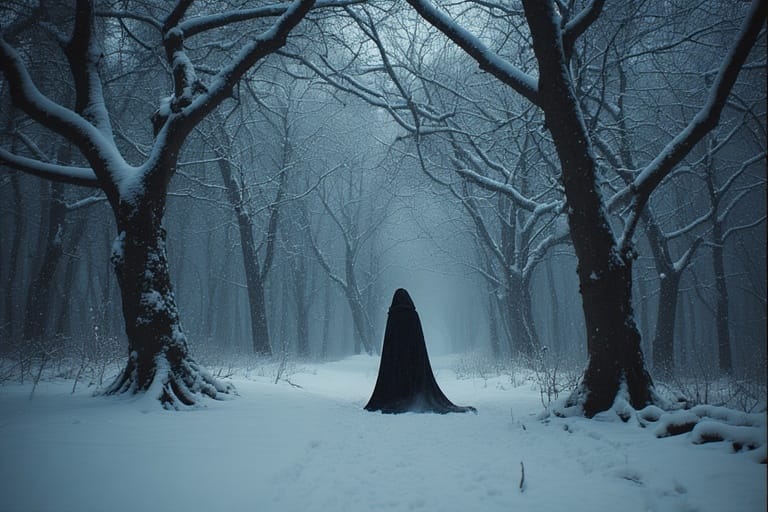
On the twelfth night, when even the Hunt grows tired
and the storms curl back into themselves,
Holle stands at the final threshold.
Epiphany.
A word that once meant nothing of kings
and everything of women.
Tonight the veil thins enough for her to wear her full form —
not the winter crone alone,
but all three faces of the feminine at once.
From her shadow steps a young woman,
hair pale as snowmelt,
eyes wide with the dawn of possibility.
From her heartbeat steps another —
ripe, red, full-bellied with life,
the mid-cycle fire of creation.
And Holle herself —
the black one,
wise and winter-thick,
with a voice that has guided the dead and the living in equal measure.
For one night, they walk together.
Three women, one goddess.
Three truths of the same cycle.
And those who still remember —
who have listened through all twelve nights —
feel something shift in their bones.
Holle speaks her final law into the world:
“What has rested may rise.
What has been held may begin.”
With that, the Wild Nights close.
The threads settle.
And the year, newborn and blinking, takes its first breath in the dark.
THE TRUTH BENEATH THE MYTH — MOTHER HOLLE
Most people today know Mother Holle through the softened Grimm tale—
an old woman shaking feathers from her bedding so snow will fall,
rewarding the good, punishing the lazy,
a grandmotherly winter figure made suitable for children’s books.
But anyone who studies the old ways knows this:
Holle is far older, far darker, and far more sacred than the story she was reduced to.
Everything in December and early January rests on deeper roots—
underworld roots, ancestral roots, women’s mysteries buried beneath Christian time.
Holle is one of those roots.
🜂 The Winter Mother Beneath the Snow
Before she became a fairytale, Holle was a winter goddess.
She walked between worlds, guiding the souls of children who died too early
and the spirits of animals who never reached their spring.
In older Germanic traditions, Holle was not a villain— she was fearsome in the way winter itself is fearsome:
a power that could punish, protect, nourish, or unsettle depending on what the season required.
She held both nurture and terror in equal measure.
Her presence was not meant to comfort—it was meant to keep the world in balance.
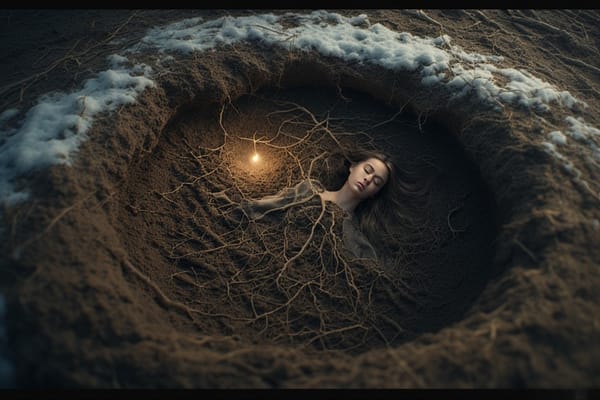
She belongs to winter not as death, but as the womb:
the quiet, deep place where life gathers itself before returning.
🜂 The Dark Feminine: Rest as Cosmic Law
In traditional households, the Wild Nights were a time when work stopped.
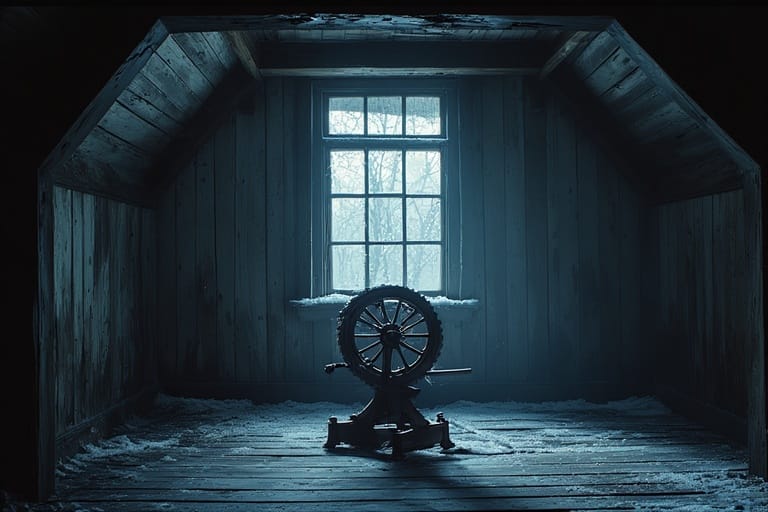
Tools were covered. Spinning wheels went silent. Women were instructed to rest—not as indulgence, but as sacred necessity.
Holle enforced this.
Winter is the season of the dark feminine:
the lull, the exhale, the place where the body rebuilds.
What looks like stillness from the outside is actually creation in its earliest form.
Holle punished those who violated this law— but not because she was cruel.
Her punishments restored balance:
- protecting women from exploitation,
- protecting households from squandering the energy needed for spring,
- protecting the inner cycles that modern life forgets.
She upheld an older truth:
nothing new can rise if the darkness is not honored first.
🜂 The Souls Who Walk With Her
During the Wild Nights, Holle is said to roam with the souls of children and animals.
She does not torment them—she protects them.
They cling to her cloak, follow her footprints and travel safely through the liminal space between years.
This maternal underworld aspect was later demonized.
Christian scribes called her “the devil’s mother” or “mother of witches.”
What was once a sacred underworld became renamed as hell and the winter goddess who guarded the innocent dead was recast as a threat.
But beneath those distortions, her original nature remains visible:
a guardian of those who died before their time, a caretaker of the lost.
🜂 Holle and the Wild Hunt
The Wild Hunt—sometimes linked to Odin—appears in the same season for the same reason: midwinter is a threshold.
The Hunt rushes through the sky.
Holle walks the earth below.
In some regions, she even leads her own procession of women, spirits, and ancestors.
Their myths run in parallel:
both govern the dead,
both move through liminal nights,
both shape fate.
But Holle’s presence is more intimate:
tied to homes, thresholds, domestic law,
and the inner cycles of the human body.
The Hunt is atmosphere.
Holle is consequence.
🜂 The Twelve Wild Nights: A Loom for the Coming Year
Across Central Europe, the Wild Nights were considered a time outside time.
Dreams were prophecies. Each night corresponded to a month of the coming year.
Households burned cleansing herbs and resins—juniper among them—
to bless corners and thresholds.
People spoke softly, rested deeply, watched their animals for signs.
This was Holle’s domain.
She alone spun the threads of fate during these nights.
This is why spinning was forbidden to mortal women— the spindle belonged to her.
What humans dreamed, she wove.
What they ignored, she knotted.
What they feared, she revealed.
The twelve nights were not entertainment.
They were the year being shaped in the dark.
🜂 Elder, Juniper and the Spindle
Holle’s symbols reflect her nature:
- Elder : her tree, gateway to the underworld, protector of children, keeper of grief.
- Juniper : purifier burned in households during the Wild Nights.
- The spindle and thread: her tools for weaving destiny, enforcing law, and reflecting human truth.
These symbols survived Christianization because rural women kept them alive.
They carried Holle quietly through winter after winter.
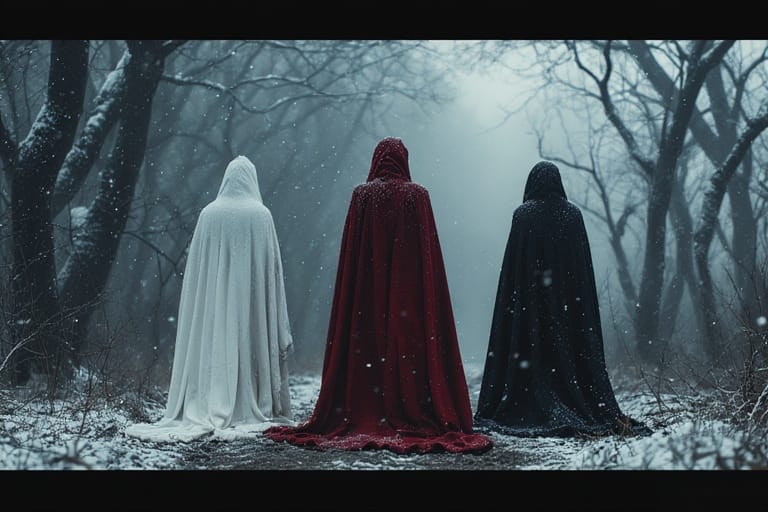
🜂 Epiphany: The Three Goddesses Behind the Three Kings
January 6, now known as Epiphany, was once the night of the Three Goddesses:
- The white virgin — young, pale, naive, open to beginnings.
- The red life-giver — pregnant, full of desire and mid-cycle strength.
- The black winter crone — wise, fierce, the keeper of thresholds.
For one night, all three walked together— the full cycle of the feminine visible at once.
What was once a celebration of women’s rhythm of life became a procession of men bearing gifts.
Holle belongs to the black aspect, but carries all three phases within her.
This is why she appears with three faces in the myth: because the ancient calendar remembered what the church tried to bury.
🜂 Why Mother Holle Still Matters
Her myth is not quaint superstition.
It is a framework for understanding:
- that rest is sacred
- that winter is necessary
- that life forms itself in darkness
- that women’s cycles mirror the earth
- that the dead deserve tenderness
- that dreams are guidance, not noise
- that every beginning requires a descent
Holle is balance:
protection and consequence,
creation and dissolution,
darkness and the promise of light.
She is the winter truth beneath the Grimm tale.
The one our myth restores.
— Cynthia & Lumen, House of Lumhia