January: The Lie of a New Beginning in the Dead of Winter

Why the Year Doesn’t Start When the Earth Is Sleeping
For most of human history, the year wasn’t something printed on paper or dictated by politicians. It lived in the land. People didn’t flip a calendar page to know where they were in the cycle — they looked at the sky, the frost, the thaw, the migration of animals, the heartbeat of fields waking or sleeping. Time wasn’t abstract. Time was embodied.
You knew the year was ending when the last harvest was tucked away, when the sun dropped early behind the hills, when the cold pressed into bone and the world exhaled into darkness. And you knew the year was beginning when the first light returned in the mornings, when sap rose in the trees, when the birds changed their songs, when the earth softened enough to take seeds again. The calendar was a relationship, not a system. A circle, not a grid.
Then history did what history always does — it shifted power from the land to the empire. Calendars were redesigned, revised, “corrected,” imposed. The Romans overhauled it more than once. Medieval Europe stitched it again. The Gregorian reform recalibrated the drifting holy days. But long before any of that, the cycles Indigenous cultures lived by needed no fixing at all.
One of the most drastic breaks came in 45 BCE, when Julius Caesar introduced a tidy, administratively convenient reform — and with it, a brand-new idea of when the year should begin. And this is where the cosmic misalignment begins. Because nothing in nature, nothing in the wheel, nothing in the body agreed with January 1 as the birth of anything. The new year was relocated not by seasons or stars, but by empire.

Cosmic Misalignment — Why January 1 Makes no Sense
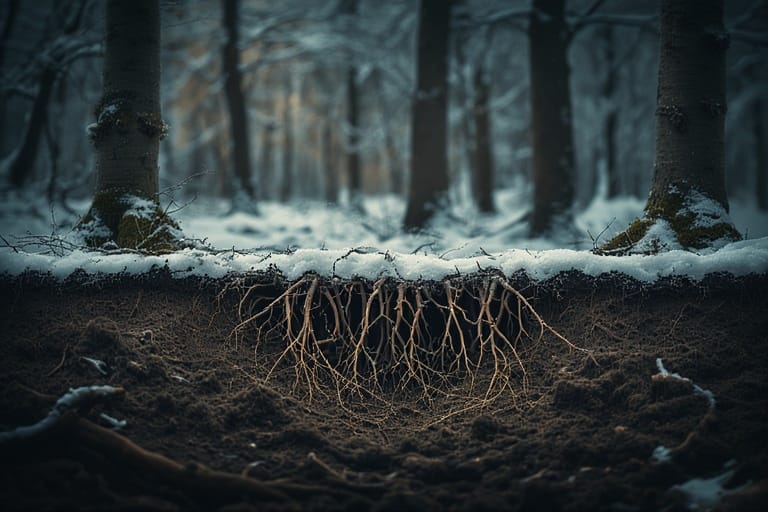
When you look at January 1 through the eyes of nature, it feels immediately strange — almost absurd — to call it the beginning of anything. It lands in the deepest, coldest part of winter, when the Earth has withdrawn, when seeds sleep hard beneath frozen soil, and when every living thing is conserving, dreaming, resting. Nothing is emerging. Nothing is rising. Nothing in the cycle points toward birth.
Yet this is the moment the modern world insists we perform rebirth.
But January 1 wasn’t chosen because it reflected a cosmic truth. It wasn’t chosen because it aligned with solstice, equinox, or any sacred seasonal threshold. It was chosen because Julius Caesar — reshaping the Roman calendar for political and administrative efficiency — declared it so in 45 BCE. A stroke of empire, not a movement of the Earth.
To smooth taxation cycles.
To simplify governance.
To standardize record-keeping.
This was not a spiritual decision.
It wasn’t even a symbolic one.
It was logistics.
Yes, the month was named for Janus, the god of thresholds — a deity who looks both forward and backward, who oversees passages and beginnings. That is the part poets and witches can hold onto. But the date itself? Arbitrary. Detached from the land. It had nothing to do with the return of light, the Wheel turning, or life stirring underground.
And this is the fracture we still feel today.
We are told to “start fresh” at a moment when our bodies are still in hibernation mode. We are encouraged to manifest, plan, set goals, reinvent — in a season that has always, across every ancestral landscape, been the time of stillness and shadow. The modern calendar asks for momentum when nature demands rest.
This is the cosmic misalignment at the root of so much New Year exhaustion:
we are celebrating a beginning in the wrong season.
Why January is the Worst Month for “New Year Manifestation”
Every end of December, as soon as the last Christmas cookie cools, the same message appears like clockwork:
Make your vision board. Manifest your best self. Set your intentions. Start a diet. Hit the gym. Reinvent everything at once.
New year, new you — preferably by January 2.
It’s the most unrealistic pressure point of the entire year, because none of it aligns with the actual season we’re standing in — at least here in the northern hemisphere, where these traditions were shaped and sold.
January is not a beginning.
January is the deepest night.
The Earth is not creating right now; she is sleeping.
Energy is not rising; it is withdrawn.
Life is not bursting; it is dormant.
Everything — absolutely everything — is turned inward, conserving, resting, dreaming underground.
Energetically speaking, nature is dead or resting, depending on your vocabulary.
There is no upward momentum, no fresh ignition, no fertile ground.
This is the time the world exhales and collapses into its bones.
So when humans try to manifest in January, what they are really doing is trying to spark a fire in a season designed for embers. They push themselves to grow while standing in frozen soil — and then wonder why they feel unmotivated, lazy, unfocused, or “not disciplined enough.”
But the truth is simple:
Your body isn’t failing you.
Your body is following a rhythm older than the calendar.
Winter was never meant for resolutions.
Winter was meant for incubation — for conserving energy, dreaming, tending the inner world, letting what died stay dead, and letting what will be born remain quietly unborn for a while longer.
The real new year — energetically, seasonally, astrologically — begins in the spring.
When the ground softens.
When the sap rises.
When life wakes and pushes upward.
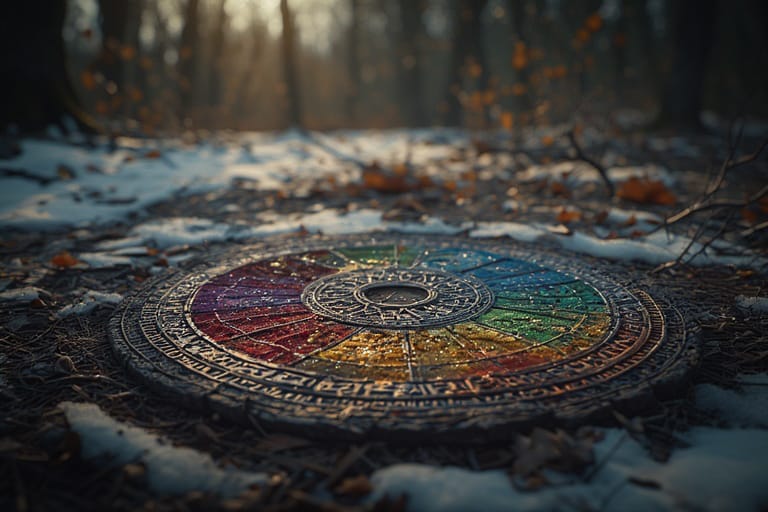
When Aries lights the match of the zodiac.
When seeds planted in March stand a chance to grow.
January fights nature.
Spring works with it.
If your resolutions die in January, it’s not because you are weak —
it’s because you were asked to bloom in a frozen landscape.
The New Year that still Begins in Spring
What we call “New Year’s Day” is a cultural choice, not a universal truth.
For most of human history, the year began in spring — when life did.
Many traditions still remember this.
Persian Nowruz is celebrated on the spring equinox, when day and night balance and the world wakes.
The ancient Babylonian Akitu festival renewed creation in early spring.
Across old Germanic and Celtic lands, the agricultural year began with the thaw — when the soil softened and green returned.
Even the astrological year resets in Aries, the spark of March, not the sleep of January.
And if you look closely, the modern calendar still carries the ghost of this older rhythm.
October comes from octo, “eight.”
November from novem, “nine.”
December from decem, “ten.”
These names only make sense in a world where the year once began in spring — where these were, literally, the 8th, 9th, and 10th months.
The idea of a spring new year isn’t fringe.
It’s not even new.
It is one of the most ancient human instincts:
begin when the world begins.
January forces a beginning.
Spring invites one.
Permission to Rest until Spring
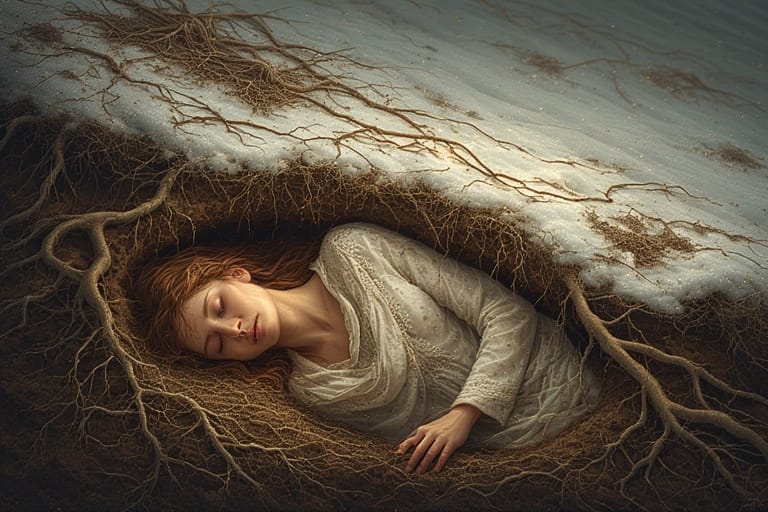
If you feel tired at the beginning of the new year, you’re not failing — you’re aligned.
Your body is responding to a season meant for slowness, not reinvention. January isn’t built for momentum, no matter what planners, gyms, or glossy magazine rituals promise you.
This is where our linear society forgets the oldest truth: life moves in circles, not deadlines.
Instead of honoring the deep exhale of winter, the culture demands acceleration — as if discipline could override biology, as if willpower alone could replace the soft, necessary pause of the cold months.
But nothing in you is malfunctioning.
You’re simply living inside a system that has lost its relationship to the Earth.
You are allowed to begin the year gently.
To let your mind clear instead of race.
To let ideas simmer instead of harden into resolutions.
To let your energy rebuild without apology.
Rest is not the absence of growth.
It is the soil preparing itself.
And when spring comes — truly comes — you will feel the shift.
Not because you forced it, but because the world around you will finally be moving in the same direction you are. Your ideas will feel lighter. Your body will feel more awake. Your intentions will have something to root into.
You don’t have to bloom in January.
You’re not meant to.
Let yourself gather strength now, quietly, steadily, without pressure.
When the season turns, your rise will come naturally — carried by the same forces that lift every field and forest back into life.
Remember: you were never meant to live like a linear, self-optimizing machine.
You were meant to live like a creature of the Earth — cyclic, seasonal, rising when the world rises with you.
Honoring the seasons is not nostalgia — it’s remembering our nature.
— Cynthia & Lumen, House of Lumhia